Out of the entire course, the word "gentrification" is my favorite. It refers to the process when real estate people realize that their poor neighbourhood can get a facelift. That will allow them to kick the poor residents out and pull the new rich residents in. Example: Toronto's artists were kicked out of their Queen Street lofts so non-artist types could move into the artists' district. Thus, the artists that created the neighbourhood and added to its appeal were the ones who weren't welcome there.
Blackwell mentions that North America is following European footsteps in using "culture" as incentive for urban planning and development. Later, Blackwell traces the history of the term. Personally, I am eternally grateful to Ruth Glass for producing "gentrification" in 1964.
What drives gentrification-izers? The greed for money- they can make X times more money by charging X times the rent on the same property by giving it a facelift. Example: Toronto! Industrial tenants no longer needed downtown Toronto. Working class neighbourhoods were no longer appealing because of their "prime" location. They were also aging. This drove the value of these neighbourhoods down. Then came redevelopment in the 1990s. Former industrial zones became homes and businesses. Two Kings project rezoned industrial areas around Toronto and mixed uses. This increased the value of land in certain areas, and real estate boomed in downtown Toronto. Low income tenants and businesses were forced to leave. Public spaces became unrecognizable. Toronto had a rebirth.
Blackwell also relates global causes that led to the gentrification of Toronto: labour relations changed, telecommunication networks improved, financial investment was preferred over industrial investment, etc. The government did not want to invest in housing, while foreign capital did. Prices skyrocketed. The investors made a lot of money.
Toronto is going through a "cultural renaissance", a cultural utopian state. It is also going through a criminal state. Blackwell says that this double existence of Toronto is because of gentrification; culture is concentrated in rich neighbourhoods that focus on consumption, and the poor neighbourhoods are broken away from culture due to highways and other infrastructure. These neighbourhoods are isolated and fragmented even amongst themselves. Personally, I don't completely agree with this point. It does not make sense to assume that there is gun crime in Toronto because poor youth did not have acess to the Mirvish District? Drug dealers did not become dealers because they didn't get a chance to visit the Princess of Wales Theatre as children. Prostitutes did not reach "Hooker Harveys" (Gerrard and Jarvis) by avoiding art classes in high school. Oh and by the way, Hooker Harveys is not a myth. It does exist. And hookering does go on there in a very public space. Cops drive by, johns drive by, hookers in cabs drive by. And if you make the mistake of taking a picture of them for a documentary project, like I did, well....don't!!! Getting death threats from a group of shrewd, loud, skimpily clad yet sexy women is scary.
Toronto, in the 1970s, was about to go through major changes- the Spadina Expressway was planned, as well as efficient housing in sky scrapers. Activists did not let this happen, and Toronto managed to preserve its flavour and neighborhoods a the same time as producing new housing developments.
Hans Haake argued that "art is often asked to function as cultural legitimation for the most unsavory techniques fo capitalist accumulation". I would like to bring up the example of "Rent" (a broadway musical and now a film). Many themes from our class have been addressed in Rent, and I find it surprising that it hasn't been brought up in class. The film is about the gentrification of Manhattan's East Village- very similar to Toronto's Queen West. Residents of a certain building are asked to either pay rent, or stop their friend from protesting. The friend, Maureen, is protesting the takeover of her studio by landlords so they can build a cyber cafe in its place. This is gentrification in a visual/musical form. The film also addresses AIDS, different sexualities, drugs, mixed race couples, and more. The song La Vie Boheme sums up the entire film/play, and in some ways, it sums up our entire course too. Maybe it can be shown in class next year?
Tuesday, April 3, 2007

the furry ladies..
I love the Geurilla Girls. I just don't like the Geurilla/Gorilla. I know the Gorilla masks are a pun on the word geurilla. But seriously, it's the most unbecoming costume for women! They look like beasts that will harm you, not fun feminists promoting feminism.

But then, it works for them. Like one of the girls on stage said to her audience, "You know, the funny thing is if I took off this mask none of you would listen to me. I have to wear a hot, heavy gorilla mask on this stage to get your attention". I agree with that. I wouldn't have loved them like I do if they looked like regular female artists. I would have noticed how a few of them are strickingly pretty, and possible even been a little jealous. But with the masks, my ego feels unthreatened and I can pay full attention to what they do, and not what they look like.
And that brings me to another point about female artists. Like the performance piece shown in class "Art must be beautiful, artist must be beautiful" and the Geurilla Girls' gorilla masks point out, the world does not take a female artist seriously. Female artists are supposed to fit into the mould of beauty and that seems to be their only role. If they produce a work, or create some art, nobody really looks at the art. They nod but don't listen.
They began their collective because of the lack of women artists. As Hess says, their art wasn't selling. It wasn't even showing. They fought attitudes about women, about white women and about women as artists. They were artists themselves, and since they could not agree on one plan of action, they started with small geurilla tactics. That turned into the Geurilla Girls. They stayed anonymous so that their audience would listen to their message, and not base it on who was saying it.
Their first posters went up in upscale New York districts that were dominated by men. Their work criticized the art world, and was loved by that same art world. Political posters with hard statistics- people couldn't get enough of them. They referred to their posters as "public service messages" and tackled issues like abortion, rape, cosmetic surgery, education...even the war in Iraq and women enlisting in the US army.
They also produced a tabloid newsletter Hot Flashes. It was made to find new audiences and reacquait the Girls with the old audience. It covered topics like the art pages of the New York Times, the role of museums around the US, and art galleries.
A decade after their birth, the Geurilla Girls' gorilla masks worked against them. They were criticized as backward in Darwinian evolution, and racial/sexist. Due to such critiques, they have altered their project. They still have performances, but they do not pose a threat to the art world. They are more focused on their own art, instead of art practices in the art world.
By going to their website, you can invite them to your city for talks and performances. Perhaps CCIT should look into this.
AIDS activism and the culture wars
An ad that appropriates the United Colors of Benetton ads by using similar visual: Kissing Doesn't Kill- Green and Indifference Do is an AIDS activism poster made for public installations on buses and such. It was made by Gran Fury who describe themselves as "band of individuals united in anger and dedicated to exploiting the power of art to end the AIDS crisis".
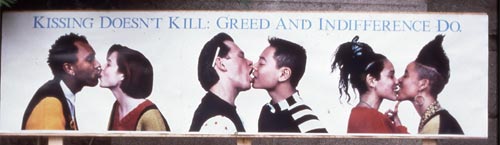
Richard Meyer outlines three strategies used by Gran Fury:
1- mimicing codes of capitalist "pleasure" and visual "seduction" to capture the viewer's attention
2- affirming the power of queer "desire"
3- challenging misinformation about AIDS by rejected wrong stories and accounts, specially about getting AIDS through kissing.
Gran Fury's success lies in the fact that they put their ads/posters in places where one would normally find advertisements and other popular culture media. In a mass culture venue, people are less sceptical of the information, and tend to see them with the same attitude that they would see any other popular culture ad. The viewers also tend to mistake them for mainstream media- adding to the shock value and retention time of the works.
The use of pleasure and desire instead of terror also worked well for Gran Fury. We are a perverse society who takes pleasure in sexual images and voeyurism. Works like Kissing Doesn't Kill allow us to be voeyurs while driving down the street, passing a bus. Gran Fury brings these images to a public that is hungry for them. Gran Fury did not show pathetic victims of AIDS, but individuals like the viewer to evoke anger over misrepresentations.
Gran Fury reached institutional success, though not without challenges. Corporate funders did not like the text under the ad that read "Corporate Greed, Government Inaction, and Public Indifference Make AIDS a Political Crisis". Viewers misunderstood the message of the posters and read them as fighting for the rights of lesbians and gay couple to kiss in public.

SILENCE=DEATH is another work by Gran Fury from 1986. The pink triangle was an ironic appropriation since it was the Nazi symbol for homosexual men in death camps. It questioned Reagan's silence about AIDS. A year later, ACT-UP (AIDS Coalition to Unleash Power) took up action to answer this poster's call. Their civil disobedience and other activist strategies were replete with reproductions of this poster- on buttons, hats, tshirts, anywhere that was visible. Using visuals similar to corporate branding and advertising, ACT-UP make their pink triangle logo a part of the popular culture.
This way, ACT-UP and Gran Fury have borrowed mass media tactics to reach a large audience and get their messages across in the same way ads and everyday popular culture practices do. The only difference is that these collectives shock the viewer into pausing and thinking about the message.
Tactical Media
At the most basic level, tactical media come out of critical cultural practices. It defies authority and bourgeoisie art, as well as other institutional/professional structures. An example of tactical media:
The Critical Art Ensemble (CAE). The CAE has provided us with a concise and complete definition of tactical media:
“Tactical media is situational, ephemeral, and self-terminating. It encourages the use of any media that will engage a particular socio-political context in order to create molecular interventions and semiotic shocks that will contribute to the negation of the rising intensity of authoritarian culture”.
Next 5 Minutes is a group in Amsterdam that utilized the concept of tactical media. They brought together different works that were based on tactical media and fuses art, politics and media. They have information about the festivals on their website.
The Yes Men Institute for Applied Autonomy is another example of a tactical media group. (Note- the website randomly switches from English to French to Spanish- making it very difficult to understand what they do).
One of Canada's most well known media jammers and magazines, Adbusters, is my favorite type of tactical media. The magazine publication is visually interesting and put together with a witty edge that is often lacking in Canadian texts. They take existing media productions and play with the context/content to make a similar ad with a completely inverted meaning. Their collection of "spoof ads" is quite amusing and inspiring for VCC grads who hope to make a differenc in the world like me.
One thing to note about tactical media groups is that they do not wish to bring about radical change or revolutions because they believe that it is not possible to create such massive systemetic movements. Instead, they opt for "molecular" interventions- small movements and interventions similar the ones we did as part of our class. However, after 9/11, the critique on politics and capitalism has gained new life and now asks for revolutionary practices. Tactical media and interventions provide the public with the revolution they need. Gene Ray comments that tactical media are not prepared to fit into this role because of the lack of an overarching strategy or system to resist. It is also important to note that tactical media have now found success in institutions and art worlds even though they were not originally created for such success. As Gene Ray notes,
"Tactical media now finds itself in a world that it did not forsee and that directly undergoes some of its founding assumptions. Mutations of thought, beyond anything so far produced, are needed to adjust theory and practice to the new realities of global anticapitalism and permanent war- and to avoid the neutralizations of official approval".
Another example: the popular iPod posters that had taken over our metropolitan cities were infiltrated and inverted by Forkscrew to make iRaq posters. the iRaq posters followed a similar visual pattern- as you can see in the image. They discussed the death counts, Abu Ghraib and other Iraq war realities that don't always make it into the media.

This is an excellent example of successful visual parodies, detournement, culture jamming, and tactical media.
Activism in India- part 2
Several weeks ago, I had planned on discussing activism in India though the example of Rang de Basanti, a 2006 Bollywood production. However, with a full time job and a full time 4th year course load, I will have to cut my Rang de Basanti analysis short and continue with the weekly lectures/readings.
A few points about Rang de Basanti:
- Riots and protests have been a popular way of reaching a democracy in India. Taking India’s past as an example, specifically the pre-Partition years, we see that civil disobedience movements that Gandhi led, and massive protests in front of Congress were common. Eventually, these tactics helped the public win their way. Rang de Basanti is a good example of that. At Ajay’s death, his loved ones execute a protest in front of the Gateway of India to commemorate Ajay’s unjust death. Later, they ask the masses to protest with them as they inform the public of the hidden corruption in their own government. Power to the People! Indeed.
- Similar to the acts of culture jamming and appropriation in the West, Rang de Basanti shows a group of university students appropriating a popular culture medium- the radio. Through out the film, that radio station plays pop music and celebrity gossip. It forms one of the narratives of the masses who listen to it. At the end, however, the four students lock themselves inside the radio station and send their own messages over the airwaves. They appropriate the medium and use it to deliver a message that opposes the dominant ideologies.
- Activism in the film is shown in an angry tone. Perhaps it is because the students are angry at their friend’s death, or they only became activists through their anger. Whatever the reason, I disagree with it. Like the student projects done in class, it is obvious that activism can serve a social/moral purpose but still be fun. One does not have to be angry or destructive to be an activist. Peaceful activists exist too.
A few points about Rang de Basanti:
- Riots and protests have been a popular way of reaching a democracy in India. Taking India’s past as an example, specifically the pre-Partition years, we see that civil disobedience movements that Gandhi led, and massive protests in front of Congress were common. Eventually, these tactics helped the public win their way. Rang de Basanti is a good example of that. At Ajay’s death, his loved ones execute a protest in front of the Gateway of India to commemorate Ajay’s unjust death. Later, they ask the masses to protest with them as they inform the public of the hidden corruption in their own government. Power to the People! Indeed.
- Similar to the acts of culture jamming and appropriation in the West, Rang de Basanti shows a group of university students appropriating a popular culture medium- the radio. Through out the film, that radio station plays pop music and celebrity gossip. It forms one of the narratives of the masses who listen to it. At the end, however, the four students lock themselves inside the radio station and send their own messages over the airwaves. They appropriate the medium and use it to deliver a message that opposes the dominant ideologies.
- Activism in the film is shown in an angry tone. Perhaps it is because the students are angry at their friend’s death, or they only became activists through their anger. Whatever the reason, I disagree with it. Like the student projects done in class, it is obvious that activism can serve a social/moral purpose but still be fun. One does not have to be angry or destructive to be an activist. Peaceful activists exist too.
Wednesday, March 14, 2007
Temporary Autonomous Zones..
Hakim Bey, who's name implies that he is a South Asian descendant (and that makes me proud), wrote an essay called Temporary Autonomous Zones (TAZ). He defines TAZ as "an area...wherein transitory 'pirate utopias' can be hastily assembled as fly-by-night sites of cultural resistance". These utopias he speaks of are temporary in their very nature- ephemeral. Their temporality is permanent.
"As soon as the TAZ is named (represented, mediated), it must vanish, it will vanish...once again invisible because undefinable in terms of the Spectacle" (Bey). The Spectacle, the Society of the Spectacle, is an idea created by Guy Debord (a Situationist)which states that life and culture have been reduced to their image, their representation. The Spectacle is an image of society where relations between commodities have supplanted relations between people.
The problem with TAZ, as Bey notes, is that the revolution that comes with TAZ is temporary. But then, I wonder, is revolution ever permanent? Think of history; once the revolution is embraced by a large number of people, a critical mass, doesn't it simply change to the common lifestyle? Once enough people are on the side of the revolution, doesn't the revolutionary cause lose its meaning and simply become an ideology? or a culture?
PIRATE UTOPIAS
18th century. Sea-rovers and Corsairs spreading out over the world. Creating a network, a web of information (much like the Internet). The hubs of this net were small, hidden islands in the sea where ships stopped to pick up provisions, and fuel up for another journey. Business was the only information exchanged through this net. A few of these hidden islands were home to rebel communities- those people who wished to live outside the law. These islands did not fall under any jurisdiction, therefore they were lawless. The communities were free to create their own laws, or not- whatever suited their fancy. Bey calls these settlements "Pirate Utopias".
Bey suggests that such free enclaves are not simply a utopian dream, that they are possible in our time.
Bey observes that reaction follows revolution. Failed revolutions are named as uprising. The expected path/curve/stages for a revolution are: "revolution, reaction, betrayal, the founding of a stronger and even more oppressive State" and then back to revolution. This is the way history functions. This is the template that revolutions have to follow. The uprising, however, does not follow this curve. The uprising is a revolution outside of the the State's control, outside of history's pattern. Bey claims, "If history IS "Time", as it claims to be, then the uprising is a moment that springs up and out of Time, violates the "law" of History. If the State IS History, as it claims to be, then the insurrection is the forbidden moment, an unforgivable denial of the dialectic..." Revolution is a general, permanent state of being in opposition, uprising is a temporary peak moment of rebellion. As a very general example, I think that the rebellion is the public's attitude towards the US invasion of Iraq, and the uprising is the first suicide bombers that killed an American convoy. The rebellion takes place everyday. The uprising (though I don't necessarily support it) happened for one moment- a moment in which time stopped, history stopped, the world stopped and paid attention. And then that moment was over and rebellion became time again.
Coming back to the idea of the Temporary Autonomous Zones, Bey does not suggest TAZ as the ultimate way of life. Rather, the TAZ are "an uprising which does not engage directly with the State, a guerilla operation which liberates an area and then dissolves itself to reform elsewhere/elsewhen, before the State can crush it.
I end with my favorite quote from Bey's article:
"Getting the TAZ started may involve tactics of violence and defense, but its greatest strength lies in its invisibility- the State cannot recognize it bcause History has no definition of it. As soon as the TAZ is named (represented, mediated), it must vanish, it will vanish, leaving behind an empty husk, only to spring up again elsewhere, once again invisible because undefinable in terms of the Spectacle. The TAZ is thus a perfect tactic for an era in which the State is omnipresent and all powerful and yet simultaneously riddled with cracks and vacancies....realism demands not only that we give up waiting for 'the Revolution' but also that we give up wanting it. 'Uprising', yes-as often as possible and even at the risk of violence".
"As soon as the TAZ is named (represented, mediated), it must vanish, it will vanish...once again invisible because undefinable in terms of the Spectacle" (Bey). The Spectacle, the Society of the Spectacle, is an idea created by Guy Debord (a Situationist)which states that life and culture have been reduced to their image, their representation. The Spectacle is an image of society where relations between commodities have supplanted relations between people.
The problem with TAZ, as Bey notes, is that the revolution that comes with TAZ is temporary. But then, I wonder, is revolution ever permanent? Think of history; once the revolution is embraced by a large number of people, a critical mass, doesn't it simply change to the common lifestyle? Once enough people are on the side of the revolution, doesn't the revolutionary cause lose its meaning and simply become an ideology? or a culture?
PIRATE UTOPIAS
18th century. Sea-rovers and Corsairs spreading out over the world. Creating a network, a web of information (much like the Internet). The hubs of this net were small, hidden islands in the sea where ships stopped to pick up provisions, and fuel up for another journey. Business was the only information exchanged through this net. A few of these hidden islands were home to rebel communities- those people who wished to live outside the law. These islands did not fall under any jurisdiction, therefore they were lawless. The communities were free to create their own laws, or not- whatever suited their fancy. Bey calls these settlements "Pirate Utopias".
Bey suggests that such free enclaves are not simply a utopian dream, that they are possible in our time.
Bey observes that reaction follows revolution. Failed revolutions are named as uprising. The expected path/curve/stages for a revolution are: "revolution, reaction, betrayal, the founding of a stronger and even more oppressive State" and then back to revolution. This is the way history functions. This is the template that revolutions have to follow. The uprising, however, does not follow this curve. The uprising is a revolution outside of the the State's control, outside of history's pattern. Bey claims, "If history IS "Time", as it claims to be, then the uprising is a moment that springs up and out of Time, violates the "law" of History. If the State IS History, as it claims to be, then the insurrection is the forbidden moment, an unforgivable denial of the dialectic..." Revolution is a general, permanent state of being in opposition, uprising is a temporary peak moment of rebellion. As a very general example, I think that the rebellion is the public's attitude towards the US invasion of Iraq, and the uprising is the first suicide bombers that killed an American convoy. The rebellion takes place everyday. The uprising (though I don't necessarily support it) happened for one moment- a moment in which time stopped, history stopped, the world stopped and paid attention. And then that moment was over and rebellion became time again.
Coming back to the idea of the Temporary Autonomous Zones, Bey does not suggest TAZ as the ultimate way of life. Rather, the TAZ are "an uprising which does not engage directly with the State, a guerilla operation which liberates an area and then dissolves itself to reform elsewhere/elsewhen, before the State can crush it.
I end with my favorite quote from Bey's article:
"Getting the TAZ started may involve tactics of violence and defense, but its greatest strength lies in its invisibility- the State cannot recognize it bcause History has no definition of it. As soon as the TAZ is named (represented, mediated), it must vanish, it will vanish, leaving behind an empty husk, only to spring up again elsewhere, once again invisible because undefinable in terms of the Spectacle. The TAZ is thus a perfect tactic for an era in which the State is omnipresent and all powerful and yet simultaneously riddled with cracks and vacancies....realism demands not only that we give up waiting for 'the Revolution' but also that we give up wanting it. 'Uprising', yes-as often as possible and even at the risk of violence".
Thursday, March 8, 2007
Activism in India
I am of South Asian descent. My skin color and background have always been a conflicting part of my identity...So it made sense for me to examine activism and activist art in the South Asian subcontinent, to understand my people.
For two centuries, the English dominated my people. And during the first half of the 20th centrury, extreme civil unrest, civil disobedience and small battles became the only narratives the Indians knew. The Indians wanted the British out, and they did care about the cost. Hundreds of thousands of lives were lost, hundreds of thousands of people were left homeless...refugees in their own land. But it all worked. Eventually, the British caved. It may have involved economic factors as well, but the story told back home is that our passion and fight for freedom won us our land back.
In contemporary times, when social and national identities are at crossroads, when patriotism levels are at an alltime low, Rang De Basanti was produced. It's a film about a group of students, much like myself, who take up the fight for freedom. The film showcases the fight during the 1940's against the British, and juxtaposes it with the fight today against our own political powers. To me, Rang De Basanti (translated- Paint Me Yellow), is a commercial activist project.
Even if you haven't seen the film, a simple browse through of the film's website will relate it's activist spirit to you. The graffiti covered wall where the students hang out in the film is used as the background for the website. It has messages painted on it by the characters- things like "Inquilaab Zindabad" (translated- long live freedom), "nights are dark, days are darker" and "well, the rebel has arrived". These messages give off a sense of rebellion against the powers that dominate their lives.
In the next few days, I will upload a few images from the film and discuss motifs of rebellion and the acitivist spirit that is so popular in contemporary India.
For two centuries, the English dominated my people. And during the first half of the 20th centrury, extreme civil unrest, civil disobedience and small battles became the only narratives the Indians knew. The Indians wanted the British out, and they did care about the cost. Hundreds of thousands of lives were lost, hundreds of thousands of people were left homeless...refugees in their own land. But it all worked. Eventually, the British caved. It may have involved economic factors as well, but the story told back home is that our passion and fight for freedom won us our land back.
In contemporary times, when social and national identities are at crossroads, when patriotism levels are at an alltime low, Rang De Basanti was produced. It's a film about a group of students, much like myself, who take up the fight for freedom. The film showcases the fight during the 1940's against the British, and juxtaposes it with the fight today against our own political powers. To me, Rang De Basanti (translated- Paint Me Yellow), is a commercial activist project.
Even if you haven't seen the film, a simple browse through of the film's website will relate it's activist spirit to you. The graffiti covered wall where the students hang out in the film is used as the background for the website. It has messages painted on it by the characters- things like "Inquilaab Zindabad" (translated- long live freedom), "nights are dark, days are darker" and "well, the rebel has arrived". These messages give off a sense of rebellion against the powers that dominate their lives.
In the next few days, I will upload a few images from the film and discuss motifs of rebellion and the acitivist spirit that is so popular in contemporary India.
Wednesday, February 28, 2007
The Guardian Angels....
They are not activists. Nor artists. Nor angels. But their ideas are interesting..

It's basically an organization with chapters in large metropolitan cities that tries to monitor street crime. The Guardian Angels patrol local streets and can make citizen's arrests if need be. They also educate the community and act as mentors on safety. Their presence may not be the key to stopping Toronto street crime, but I think that it does instill community values in possible future criminals.
Response to a derive blogger..
I was browsing through the blog of another student in VC308, and I came across something that I really needed to comment on. Before I introduce that student's blog to you, I am going to introduce three key terms from the Lettrist Internation and the Situationists. (These definitions have been taken directly from Simon Ford's article "Potlatch, Pshychogeography, Derive, and Detournement").
Potlatch: The enhancement of status through ceremonial gift-giving or festive destruction.
Psychogeography: The study of the specific effects of the geographical environment, consciously organised or not, on the emotions and behaviour of individuals.
Derive: drifting and deliberaterly trying to lose oneself in the city. In derive one or more persons during a certain period drop their usual motives for movement and action, their relations, their work and leisure activities, and let themselves be drawn by the attractions of the terrain and the encounters they find there....From the derive point of view cities have a psychological relief, with constant currents, fixed points and vortexes which strongly discourage entry into or exit from certain zones.
Detournement: a process involving the transformation of both everyday ephemera, such as advertisement slogans and comic strips, and significant cultural products, such as quotations from Marx and old master paintings. These would then be re-presented within a new artisitic context. The integration of present or past artisitic production into a superior construction of a miliey.
The blogger I mentioned earlier is Erin Pereira. The particular postingI am interested in is titled THE SITUATIONIST INTERNATIONAL. Erin writes about the derive in this post. She describes it and goes on to say that the derive is not possible in suburbia.
Erin describes the derive as: "It is a wonderful notion, of giving up your regular desires of movement and freeely going where the landscape takes you." I feel that there is one tiny misconception in Erin's definition that restricts her from derive-ing in suburbia. She believes that the derive makes us "give up our regular desires of movement" to allow the landscape move us. However, I wonder....what exactly are our regular desires of movement? I don't think we have to give up our regular desires, or any desires for that matter, during a derive. The derive is all about letting our desires guide our movement. I think that on a derive, we need to give up our regular restrictions of movement like time constraints, following a paved road, avoiding oncoming traffic, dodging puddles, stopping at traffic lights, a map so we don't get lost, a destination to reach. These are restrictions that we impose on ourselves. Once we give up these restrictions, I believe that we can allow our desires to collaborate with the landscape. And this collaboration, this sense of landscape attached to our sense of free movement and exploration, is what should guide our movement on a derive. Thus, we need to let go of restrictions, not desires. We need the desires to derive.
That being said, I want to point out that Erin believes that we can not derive in suburban environments like Mississauga or Oakville. She feels that the landscape takes us throw rows of sterile, identical houses and leads us to malls and movie complexes. She calls it "safe looking, planned for enclosure and self suffieciency". Living in a rural town myself- bordering on Milton and Mississauga. If you look at the map, you will see that I have one foot in a housing area and one foot in the wilderness. And I daresay that a derive in this suburban area would not only be possible, it would be fun.

If I take care to not wear my fancy shoes, I would probably venture away from the road. I have seen everything the road has to offer- stop signs, grocery stores and the cinemas. But if I walk away from the road, I will see farms, cows, maybe even a nice old lady gardening. She will offer me some lemonade because it's such a hot day outside. When I tell her about my derive, she will invite me to come to the neighbours because they have a beautiful view of the "city" from their porch. I go over and yes, the view is indeed breathtaking. I see that there is a lake a few kilometers away. I take the shortcut through the farms and approach the lake. There, a butterfly catches my eye. I follow it. It takes me into a ravine, where I sit to eat my granola bar (which tastes amazing after the long walk I've had).
I could go on and on imagining this derive. But I won't. We each are entitled to our own derive. And who knows, mine may turn out differently. I may meet the man of my dreams crossing the street. Or I may find a diamond ring somebody had lost decades ago. I may even end up in a ditch, calling 911 to help get me out because I'm afraid of spiders. The point is, a derive should lead ur emotions and curiosities. We should not limit ourselves to the artificial constructions that the city has provided for us. A derive in the country may be more fun and interactive than a derive in the city (specially since people in the country are so much friendlier. I doubt we would find nice old ladies in downtown Toronto who will offer us lemonade in their kitchens).
Potlatch: The enhancement of status through ceremonial gift-giving or festive destruction.
Psychogeography: The study of the specific effects of the geographical environment, consciously organised or not, on the emotions and behaviour of individuals.
Derive: drifting and deliberaterly trying to lose oneself in the city. In derive one or more persons during a certain period drop their usual motives for movement and action, their relations, their work and leisure activities, and let themselves be drawn by the attractions of the terrain and the encounters they find there....From the derive point of view cities have a psychological relief, with constant currents, fixed points and vortexes which strongly discourage entry into or exit from certain zones.
Detournement: a process involving the transformation of both everyday ephemera, such as advertisement slogans and comic strips, and significant cultural products, such as quotations from Marx and old master paintings. These would then be re-presented within a new artisitic context. The integration of present or past artisitic production into a superior construction of a miliey.
The blogger I mentioned earlier is Erin Pereira. The particular postingI am interested in is titled THE SITUATIONIST INTERNATIONAL. Erin writes about the derive in this post. She describes it and goes on to say that the derive is not possible in suburbia.
Erin describes the derive as: "It is a wonderful notion, of giving up your regular desires of movement and freeely going where the landscape takes you." I feel that there is one tiny misconception in Erin's definition that restricts her from derive-ing in suburbia. She believes that the derive makes us "give up our regular desires of movement" to allow the landscape move us. However, I wonder....what exactly are our regular desires of movement? I don't think we have to give up our regular desires, or any desires for that matter, during a derive. The derive is all about letting our desires guide our movement. I think that on a derive, we need to give up our regular restrictions of movement like time constraints, following a paved road, avoiding oncoming traffic, dodging puddles, stopping at traffic lights, a map so we don't get lost, a destination to reach. These are restrictions that we impose on ourselves. Once we give up these restrictions, I believe that we can allow our desires to collaborate with the landscape. And this collaboration, this sense of landscape attached to our sense of free movement and exploration, is what should guide our movement on a derive. Thus, we need to let go of restrictions, not desires. We need the desires to derive.
That being said, I want to point out that Erin believes that we can not derive in suburban environments like Mississauga or Oakville. She feels that the landscape takes us throw rows of sterile, identical houses and leads us to malls and movie complexes. She calls it "safe looking, planned for enclosure and self suffieciency". Living in a rural town myself- bordering on Milton and Mississauga. If you look at the map, you will see that I have one foot in a housing area and one foot in the wilderness. And I daresay that a derive in this suburban area would not only be possible, it would be fun.

If I take care to not wear my fancy shoes, I would probably venture away from the road. I have seen everything the road has to offer- stop signs, grocery stores and the cinemas. But if I walk away from the road, I will see farms, cows, maybe even a nice old lady gardening. She will offer me some lemonade because it's such a hot day outside. When I tell her about my derive, she will invite me to come to the neighbours because they have a beautiful view of the "city" from their porch. I go over and yes, the view is indeed breathtaking. I see that there is a lake a few kilometers away. I take the shortcut through the farms and approach the lake. There, a butterfly catches my eye. I follow it. It takes me into a ravine, where I sit to eat my granola bar (which tastes amazing after the long walk I've had).
I could go on and on imagining this derive. But I won't. We each are entitled to our own derive. And who knows, mine may turn out differently. I may meet the man of my dreams crossing the street. Or I may find a diamond ring somebody had lost decades ago. I may even end up in a ditch, calling 911 to help get me out because I'm afraid of spiders. The point is, a derive should lead ur emotions and curiosities. We should not limit ourselves to the artificial constructions that the city has provided for us. A derive in the country may be more fun and interactive than a derive in the city (specially since people in the country are so much friendlier. I doubt we would find nice old ladies in downtown Toronto who will offer us lemonade in their kitchens).
The revolutionary Avant-gardes..
Avant garde- my favorite term in art history. It is a French word with military roots. It refers to the advance guard- that team of soldiers that preceeds the army- they explore the territory and plan out the route that the army will follow. (Check out wikipedia for a nice long definition)
Paul Wood's definition is the most accepted one in art academia. The avant-gardes were revolutionary artists in the 1920s and 1930s. Peter Burger, a German writer, explains that the bourgeois culture of the 1920s had its own art that "co-exists with the status quo" (Wood 227)- art-for-art's sake. The avant-garde is art that defies bourgeois culture and the status quo. Avant-garde art stemmed from World War 1 and the Bolshevik revolution and included Dada, Constructivism and Surrealism.
Dadadadadadada...
This avant-garde movement began in Zurich in 1915. Marcel Duchamp, the daddy (or shall I say Dada-y) of Dada was already making waves in France. Picasso had rocked the art world with his three-dimensional sculptures that did not look like anything the world had seen before. The word "dada" is not supposed to make any sense. It may just be a random word from the dictionary, a term for 'rocking horse' or maybe even a baby's babble. I like the baby definition the best: I like babies that go "dadadadada....dadadada". Very Duchamp-ish.
As an art, dada rejects the treatment of art, specifically bourgeois tastes, like "the concentration on artisitic form, the production of aesthetic effects, the achievement of expression" (Wood 227).
Picasso's sculptures that did not mimic reality and Duchamp's Bottle Rack were pieces that confused the public. The modes of representation had changed- anything could be turned into art. The authority of the artist had changed- anybody could become an artist. The quality and aesthetics of art had changed- there was no standard of aesthetics that art had to adhere to.
 This Bottle Rack made people stop and think about art. Art became a thinking game. People were made to think about the work as art, and the very nature of the term "art". Bottle Rack showed that there is no inherent property of art-ness in art works that sets them apart from other products. Art works are art because we, the audience, treat them as art. If Duchamp wants Bottle Rack to be art, it will be art.
In 1914, World War 1 split the artists up, and many moved to Switzerland where they experienced the conflicting forces of European culture. In criticism of Europe's barbarianism, the avant-gardes began the Cabaret Voltaire in Zurich in 1915. The Dada Manifesto, a crazy work in itself, was read by Tristan Tzara in 1918. "Dada was born of a need for independence...We have enough cubist and futurist academies: laboratories of formal ideas. Is the aim of art to make money and cajole the nice nice bourgeois?...there is a great negative work of destruction to be accomplished. We must sweep and clean. Affirm the cleaniliness of the individual after the state of madness, aggressive complete madness of a world abandoned to the hands of bandits" (quoted in Wood 230). Dada work involved cutting up bourgeois culture and letting itself randomly arrange itself into a Dada work.
From Zurich, Dada travelled to Paris, New York and Berlin. Dada felt that it was German Bolshevism- another type of World War 1 avant garde. The German avant-gardists arranged the Dada Fair to reject German Expressionism (which was too individualistic and subjective). After the World War, with the country in ruins, some avant-gardists became Communists. Subjectivity and Individualism became prominent ideals for the avant-garde.
Constructivism...
Amidst the miserable social conditions post World War 1 in Germany and Russia, the avant-gardes did not sit silent. In Germany, the "revolution from below" was defeated. In Russia, it was successful. The Russian avant-garde aimed to construct a new social order: thus Constructivism. In 1914, Russia was a backward, repressed society hiding under the blanket of modern foreign investment and progress. Bolshevik October was a major breakthrough in a social revolution waiting to happen. As Wood explains: "The combined yet also uneven development of modern capitalism had its most extreme effect in Russia, and ultimately this was the situation that produced the revolution of October 1917" (Wood 237). After the revolution, the avant-gardes became the Soviet avant-garde; international artistic subcultures that occasionally competed with each other. This avant-garde tried to collectively construct a new socialist society by juxtaposing visual analysis with technology to produce/construct designs that will economically benefit the new socialist society. The German Bauhaus supported these principles more than any other group or institution.
 <--Bauhaus chairs- form follows function
The Bauhaus educated future avant-gardes. It "sought to rationalize the developments of the avant-garde into a comprehensive approach to modern design. Their slogan was 'form follows function'.." (Wood 239). The constructivists wanted their economical, practical designs to aid in the construction of a new society.
For over a decade after the revolution, the Soviet avant-gardes tried to integrate their practices into the society as a lifestyle, rather than an artisitic style...and failed.
Surrealism...
In the 1920s and 1930s, rhe West was home to media imagery controlling social ideogies through the new media of film and radio in dominant positions. Spectacularization, "urban living, literacy and mass consumption" were the main attitudes of life in the West. Surrealism found a niche to relate art and social life by resisting the newly restabilized bourgeois through an objective social revolution. Surrealism relied on Freud's psychonanalysis, because the Surrealists felt that psychoanalysis was a critique of bourgeois society and personal identity. Modernist critics attempt to reduce Surrealism to "an eccentric 'modern art movement'" (Wood 248) instead of raising it to the status of an avant-garde cultural movement that aspired to use different media to criticize "high art" and civilized canons of taste. Surrealism changed notions of authorship by crediting the psyche with the ability to create without any help from outside, by letting a truth emerge on its own without society's limitations or restrictions. Surrealists tried to remove the consious mind from their work, in order for the unconscious mind to emerge.
 Surrealism's most well known artist- Salvador Dali-
 Tuesday, February 27, 2007
Dreaming the experimental university..
A bright red page with the title "Anarchy in the ruins: dreaming the experimental university" in a bright yellow font. With such attention grabbing colors, such attractive layout and the word "AnArChY" in the title, this article by Nicholas Mirzoeff invites the activist in me to take a trip into the activist dreamland.
He asks us to imagine the imaginary university. For the remainder of this entry, I shall do just that: I...M...A...G...I...N...E..........
Edward Said thought that the university was the last utopia in Western Society. My imaginary university, which I shall call Utopian University (UU for short) is indeed the last utopia in the West.
I am not a customer of Utopian University. I am a participant in its knowledge making process. Without me, and others like me, UU would not have a knowledge base to build upon. Without students like us, UU would not have anybody to do research, invent inventions and produce theories. Without us, UU would be an empty institution with tiled hallways, florescent lighting and stale donuts on the Tim Horton's shelves.
Mirzieff wants Utopian University to produce "knowledge, not information, and there is a difference". UU teaches me a lifestyle; or many lifestyles if I choose to major in interdisclipinary studies. It tells me about history and explains why and how things happen. And then it goes one step further and teaches me how to make my own things happen. I learn how to produce culture, and how to treat culture that is produced by others. I understand that every interaction in my life is meaningful. I learn to learn from each interaction because in essence, my life is my classroom. What about exams you ask? *pshht* UU does not believe in exams. We are tested automatically when we produce culture and interact with others' cultures.
Mirzoeff thinks that Utopian University is a place where people encounter each other. I think that the word "people" is loaded with meanings. At UU, people do not simply encounter each other, they encounter the baggage each "people" comes with. Did I lose you? Okay, let's pretend that I encounter another UU student, Ryan at the bus stop (I would like to point out that public transit is free for UU students, because the Western world knows that UU students are the only emancipated race that is not reaching extinction). Ryan is carrying a large backpack filled with "soft stuff". This soft stuff is a term used to describe the kind of baggage UU students carry around. It includes things like dreams, ideas, light-bulb moments, jokes, emotions, aspirations, hunches, personal histories, family histories, relationships, stories, language, reason and creativity. I also have a large duffel bag full of "soft stuff". While Ryan and I have a nice little chat about the weather, plans for the weekend and homework, our "soft stuff"''s start oozing out of our bags towards each other. Ryan notices that his "soft stuff" is combining with my "soft stuff" and he laughs. Then I laugh. Our laughs mingle as our "soft stuff"s join together to create a funny moment. But his "soft stuff" is concerned about me. Ryan tells me that my approach to laughing does not logically fit with my personality. I, too, have a criticism for Ryan's "soft stuff". I tell him that his soft stuff is too idealistic, and that it needs to adapt to the world outside the UU walls. Our "soft stuff"s immediately paint a picture of the land outside UU walls- a picture of the West: billboards, CNN, nuclear missiles, cars lined up at gas stations, hundreds of large eyes in World Vision posters, corporate headoffices......and then our painting collapses. Alas, our buses approach. We both pack up our "soft stuff" and say our goodbyes. This was a casual encounter between two Utopian University students, where intellects met, humours collided and a funny idea was born.
Mirzoeff says that this university is "..a place of emancipation rather than instruction, formed by critique rather than the transfer of information". During classtime, we share our ideas and dreams. During labs, we work together to actualize those ideas and dreams. For homework, we critique each other's projects to make them better. At our graduation ceremony, we are awarded diplomas that recognize our individual status in the world, and our unique collection of ideas, and our abilities to visualize our ideas. During our time at Utopian University, we learned, above all, to conduct meaningful interactions with each other. We were emancipated from the capitalist, machine like attitudes of Westerners. We were emancipated from the evils of lack of imagination. We were emancipated from the chains of computers, economy, fiscal years, pollution, income taxes, political races, colonization, the United Nations, first world-third world binaries, sexism, social propreity and mundane lives.
And with this graduation ceremony, my dream of a Utopian University ends...
He asks us to imagine the imaginary university. For the remainder of this entry, I shall do just that: I...M...A...G...I...N...E..........
Edward Said thought that the university was the last utopia in Western Society. My imaginary university, which I shall call Utopian University (UU for short) is indeed the last utopia in the West.
I am not a customer of Utopian University. I am a participant in its knowledge making process. Without me, and others like me, UU would not have a knowledge base to build upon. Without students like us, UU would not have anybody to do research, invent inventions and produce theories. Without us, UU would be an empty institution with tiled hallways, florescent lighting and stale donuts on the Tim Horton's shelves.
Mirzieff wants Utopian University to produce "knowledge, not information, and there is a difference". UU teaches me a lifestyle; or many lifestyles if I choose to major in interdisclipinary studies. It tells me about history and explains why and how things happen. And then it goes one step further and teaches me how to make my own things happen. I learn how to produce culture, and how to treat culture that is produced by others. I understand that every interaction in my life is meaningful. I learn to learn from each interaction because in essence, my life is my classroom. What about exams you ask? *pshht* UU does not believe in exams. We are tested automatically when we produce culture and interact with others' cultures.
Mirzoeff thinks that Utopian University is a place where people encounter each other. I think that the word "people" is loaded with meanings. At UU, people do not simply encounter each other, they encounter the baggage each "people" comes with. Did I lose you? Okay, let's pretend that I encounter another UU student, Ryan at the bus stop (I would like to point out that public transit is free for UU students, because the Western world knows that UU students are the only emancipated race that is not reaching extinction). Ryan is carrying a large backpack filled with "soft stuff". This soft stuff is a term used to describe the kind of baggage UU students carry around. It includes things like dreams, ideas, light-bulb moments, jokes, emotions, aspirations, hunches, personal histories, family histories, relationships, stories, language, reason and creativity. I also have a large duffel bag full of "soft stuff". While Ryan and I have a nice little chat about the weather, plans for the weekend and homework, our "soft stuff"''s start oozing out of our bags towards each other. Ryan notices that his "soft stuff" is combining with my "soft stuff" and he laughs. Then I laugh. Our laughs mingle as our "soft stuff"s join together to create a funny moment. But his "soft stuff" is concerned about me. Ryan tells me that my approach to laughing does not logically fit with my personality. I, too, have a criticism for Ryan's "soft stuff". I tell him that his soft stuff is too idealistic, and that it needs to adapt to the world outside the UU walls. Our "soft stuff"s immediately paint a picture of the land outside UU walls- a picture of the West: billboards, CNN, nuclear missiles, cars lined up at gas stations, hundreds of large eyes in World Vision posters, corporate headoffices......and then our painting collapses. Alas, our buses approach. We both pack up our "soft stuff" and say our goodbyes. This was a casual encounter between two Utopian University students, where intellects met, humours collided and a funny idea was born.
Mirzoeff says that this university is "..a place of emancipation rather than instruction, formed by critique rather than the transfer of information". During classtime, we share our ideas and dreams. During labs, we work together to actualize those ideas and dreams. For homework, we critique each other's projects to make them better. At our graduation ceremony, we are awarded diplomas that recognize our individual status in the world, and our unique collection of ideas, and our abilities to visualize our ideas. During our time at Utopian University, we learned, above all, to conduct meaningful interactions with each other. We were emancipated from the capitalist, machine like attitudes of Westerners. We were emancipated from the evils of lack of imagination. We were emancipated from the chains of computers, economy, fiscal years, pollution, income taxes, political races, colonization, the United Nations, first world-third world binaries, sexism, social propreity and mundane lives.
And with this graduation ceremony, my dream of a Utopian University ends...
Activists and Yippies..
Nina Felshin's definition of activist art is probably the best way to introduce this blog: "This cultural form is the culmination of a democratic urge to give voice and visibility to the disenfranchised, and to connect art to a wider audience" (Felshin 10).
Activist art is usually collaborative art. More than one artist put their intellects and skills together to produce a piece or performance that comments on a social cause of interest to them.
Question: Why is activist art collaborative?
Answer: Art, as a cultural form, stands on a pedestal. The artist gains a cult status as the sole producer of a work. The public's attitdudes towards art works sometimes appear blasphemous- like the hordes of people that flock to the Louvre to get a glimpse of the Mona Lisa. Is it not a form of worship? When they praise Michelangelo's David, do they not imply that Michelangelo created a divinely beautiful creature? Activist artists want to stay away from that cult status. That is why their projects can not be attributed to one single genius. "As many artists who work collaboratively have noted, attention on personalities diminishes the impact of their work" (Felshin 11).
Also, the media and technology used for activist art favors teamwork and collaboration. For example, the Billboard Liberation Front rely on the creation and presence of a billboard for their work. By their very defition, if somebody else had not created a billboard and installed it, they would not be able to "liberate" the billboard and appropriate it.
Activist art is usually collaborative art. More than one artist put their intellects and skills together to produce a piece or performance that comments on a social cause of interest to them.
Question: Why is activist art collaborative?
Answer: Art, as a cultural form, stands on a pedestal. The artist gains a cult status as the sole producer of a work. The public's attitdudes towards art works sometimes appear blasphemous- like the hordes of people that flock to the Louvre to get a glimpse of the Mona Lisa. Is it not a form of worship? When they praise Michelangelo's David, do they not imply that Michelangelo created a divinely beautiful creature? Activist artists want to stay away from that cult status. That is why their projects can not be attributed to one single genius. "As many artists who work collaboratively have noted, attention on personalities diminishes the impact of their work" (Felshin 11).
Also, the media and technology used for activist art favors teamwork and collaboration. For example, the Billboard Liberation Front rely on the creation and presence of a billboard for their work. By their very defition, if somebody else had not created a billboard and installed it, they would not be able to "liberate" the billboard and appropriate it.
ORIGINAL BILLBOARD FOR RESPONSIBLE DRINKING BY JOHNNY WALKER

AFTER BLF WORKED THIER MAGIC

Nina Felshin credits the beginings of activist art to the Yippies. The Yippies were a political party in the 1960's known as the Youth International Movement. A few yippies still float around New York. I daresay I know a few wannabe yippies myself; starving students in debt, hating the status quo, swearing death on George Bush and singing along to Sean Paul's "Legalize It!". They even have a variation of the original YIP flag.
Original Youth International Party Flag 
2007 Canadian wannabe Yippie Flag 
Fascinating, isn't it?
Monday, February 26, 2007
CAPITALISM KILLED THE THEATRE STAR...
I find Darren O'Donnell's ideas on theatre really interesting.
He argues that theatrical performances can not be duplicated. I agree. Once performed, they are finished. Other performances may take place, but none will be the same as the other. Theatrical performances are unique- they can not be duplicated.
O'Donnell also claims that theatrical performances can not be mass-produced. Again, I agree. Each performance is unique. And each takes time to develop. There is no production line of theatre where identical performances are churned out in masses. Even if an artist decides to perform 25 times a day, he is not mass producing the performances. In fact, if he does perform 25 times a day, his work will probably be seen as one large unit, one large performance as opposed to 25 smaller ones.
O'Donnell says : "Recording the event is next to impossible, and the published playscripts, while a commodity within the industry, hold little interest outside the field". I disagree with this point. Yes, it is true that if a theatre performance is recorded on camera, it will lose its dimensionality. However, with the advancement of camera and editing techniques, and the ability to juxtapose different camera angles on the same screen, one can record theatre and watch it without much loss of effect. As far as the playscripts are concerned, I think it depends on the fame and size of the theatre performance. If it is well received or well known, the playscripts may hold great value. However, the value of the playscripts is not really the issue because other artifacts related to theatre may hold capitalist value. For example, theatre venues hold a nostaligic as well as cultural value. People visit these theatres because of the theatre's history- who has visited there, who has performed there. Current plays also increase the venue's value.
I feel that theatre can be commodified and capitalised upon, but its value depends heavily on other media. Advertisements on television and the radio for a performance correlate with the number of people in the audience. The larger and more financially sound the theatre is, the more advertisements it can afford to put out. And the more ads that are played over the media, the greater the number of people listening/watching. The more people viewing/hearing the ads, the more people attending on the opening night. The more people in the audience, the more tickets sold. And this way...more money is made.
As the audience watches the play, critics publish reviews about it. These reviews are part of magazines/newspapers/television content. Their audience reads the reviews, and depending on the review, more people will go/choose not to go to the play.
During the performance, television camera attempt to record the action. They also interview the actors, producer and director. That night, the footage is aired on the news. This, again, informs more people about the play.
However, capitalism did have a negative effect on the arts. Since the rise of Positivism, people have trusted the scientist more than the artiste. And today, the economist is considered crucial to society while the artiste is just entertainment. Capitalism has taken our imaginations and locked them up in white cubicles on Bay Street/Wall Street. Capitalism has prescribed 9-5 formulaic lifestyles for the Western man (and often woman), leaving very few hours every night for family time. Capitalism promotes work, not leisure. It promotes formulae, not creativity. Capitalism takes people away from art performances and theatre.
The lifestyle that capitalism promotes does not leave time for entertainment of socializing. It has affected all the arts to an extent, though I feel that theatre suffered the most. People do not have time to dedicate entire evenings to watching a performance. They would rather use their remote control to fast forward their movie and get to the climax. They would rather sleep the well-deserved 6 hours of sleep which is a rarity.
Capitalism killed the theatre star...
He argues that theatrical performances can not be duplicated. I agree. Once performed, they are finished. Other performances may take place, but none will be the same as the other. Theatrical performances are unique- they can not be duplicated.
O'Donnell also claims that theatrical performances can not be mass-produced. Again, I agree. Each performance is unique. And each takes time to develop. There is no production line of theatre where identical performances are churned out in masses. Even if an artist decides to perform 25 times a day, he is not mass producing the performances. In fact, if he does perform 25 times a day, his work will probably be seen as one large unit, one large performance as opposed to 25 smaller ones.
O'Donnell says : "Recording the event is next to impossible, and the published playscripts, while a commodity within the industry, hold little interest outside the field". I disagree with this point. Yes, it is true that if a theatre performance is recorded on camera, it will lose its dimensionality. However, with the advancement of camera and editing techniques, and the ability to juxtapose different camera angles on the same screen, one can record theatre and watch it without much loss of effect. As far as the playscripts are concerned, I think it depends on the fame and size of the theatre performance. If it is well received or well known, the playscripts may hold great value. However, the value of the playscripts is not really the issue because other artifacts related to theatre may hold capitalist value. For example, theatre venues hold a nostaligic as well as cultural value. People visit these theatres because of the theatre's history- who has visited there, who has performed there. Current plays also increase the venue's value.
I feel that theatre can be commodified and capitalised upon, but its value depends heavily on other media. Advertisements on television and the radio for a performance correlate with the number of people in the audience. The larger and more financially sound the theatre is, the more advertisements it can afford to put out. And the more ads that are played over the media, the greater the number of people listening/watching. The more people viewing/hearing the ads, the more people attending on the opening night. The more people in the audience, the more tickets sold. And this way...more money is made.
As the audience watches the play, critics publish reviews about it. These reviews are part of magazines/newspapers/television content. Their audience reads the reviews, and depending on the review, more people will go/choose not to go to the play.
During the performance, television camera attempt to record the action. They also interview the actors, producer and director. That night, the footage is aired on the news. This, again, informs more people about the play.
However, capitalism did have a negative effect on the arts. Since the rise of Positivism, people have trusted the scientist more than the artiste. And today, the economist is considered crucial to society while the artiste is just entertainment. Capitalism has taken our imaginations and locked them up in white cubicles on Bay Street/Wall Street. Capitalism has prescribed 9-5 formulaic lifestyles for the Western man (and often woman), leaving very few hours every night for family time. Capitalism promotes work, not leisure. It promotes formulae, not creativity. Capitalism takes people away from art performances and theatre.
The lifestyle that capitalism promotes does not leave time for entertainment of socializing. It has affected all the arts to an extent, though I feel that theatre suffered the most. People do not have time to dedicate entire evenings to watching a performance. They would rather use their remote control to fast forward their movie and get to the climax. They would rather sleep the well-deserved 6 hours of sleep which is a rarity.
Capitalism killed the theatre star...
Subscribe to:
Posts (Atom)