An ad that appropriates the United Colors of Benetton ads by using similar visual: Kissing Doesn't Kill- Green and Indifference Do is an AIDS activism poster made for public installations on buses and such. It was made by Gran Fury who describe themselves as "band of individuals united in anger and dedicated to exploiting the power of art to end the AIDS crisis".
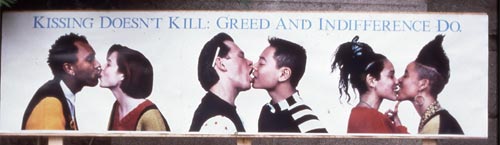
Richard Meyer outlines three strategies used by Gran Fury:
1- mimicing codes of capitalist "pleasure" and visual "seduction" to capture the viewer's attention
2- affirming the power of queer "desire"
3- challenging misinformation about AIDS by rejected wrong stories and accounts, specially about getting AIDS through kissing.
Gran Fury's success lies in the fact that they put their ads/posters in places where one would normally find advertisements and other popular culture media. In a mass culture venue, people are less sceptical of the information, and tend to see them with the same attitude that they would see any other popular culture ad. The viewers also tend to mistake them for mainstream media- adding to the shock value and retention time of the works.
The use of pleasure and desire instead of terror also worked well for Gran Fury. We are a perverse society who takes pleasure in sexual images and voeyurism. Works like Kissing Doesn't Kill allow us to be voeyurs while driving down the street, passing a bus. Gran Fury brings these images to a public that is hungry for them. Gran Fury did not show pathetic victims of AIDS, but individuals like the viewer to evoke anger over misrepresentations.
Gran Fury reached institutional success, though not without challenges. Corporate funders did not like the text under the ad that read "Corporate Greed, Government Inaction, and Public Indifference Make AIDS a Political Crisis". Viewers misunderstood the message of the posters and read them as fighting for the rights of lesbians and gay couple to kiss in public.

SILENCE=DEATH is another work by Gran Fury from 1986. The pink triangle was an ironic appropriation since it was the Nazi symbol for homosexual men in death camps. It questioned Reagan's silence about AIDS. A year later, ACT-UP (AIDS Coalition to Unleash Power) took up action to answer this poster's call. Their civil disobedience and other activist strategies were replete with reproductions of this poster- on buttons, hats, tshirts, anywhere that was visible. Using visuals similar to corporate branding and advertising, ACT-UP make their pink triangle logo a part of the popular culture.
This way, ACT-UP and Gran Fury have borrowed mass media tactics to reach a large audience and get their messages across in the same way ads and everyday popular culture practices do. The only difference is that these collectives shock the viewer into pausing and thinking about the message.

No comments:
Post a Comment