Out of the entire course, the word "gentrification" is my favorite. It refers to the process when real estate people realize that their poor neighbourhood can get a facelift. That will allow them to kick the poor residents out and pull the new rich residents in. Example: Toronto's artists were kicked out of their Queen Street lofts so non-artist types could move into the artists' district. Thus, the artists that created the neighbourhood and added to its appeal were the ones who weren't welcome there.
Blackwell mentions that North America is following European footsteps in using "culture" as incentive for urban planning and development. Later, Blackwell traces the history of the term. Personally, I am eternally grateful to Ruth Glass for producing "gentrification" in 1964.
What drives gentrification-izers? The greed for money- they can make X times more money by charging X times the rent on the same property by giving it a facelift. Example: Toronto! Industrial tenants no longer needed downtown Toronto. Working class neighbourhoods were no longer appealing because of their "prime" location. They were also aging. This drove the value of these neighbourhoods down. Then came redevelopment in the 1990s. Former industrial zones became homes and businesses. Two Kings project rezoned industrial areas around Toronto and mixed uses. This increased the value of land in certain areas, and real estate boomed in downtown Toronto. Low income tenants and businesses were forced to leave. Public spaces became unrecognizable. Toronto had a rebirth.
Blackwell also relates global causes that led to the gentrification of Toronto: labour relations changed, telecommunication networks improved, financial investment was preferred over industrial investment, etc. The government did not want to invest in housing, while foreign capital did. Prices skyrocketed. The investors made a lot of money.
Toronto is going through a "cultural renaissance", a cultural utopian state. It is also going through a criminal state. Blackwell says that this double existence of Toronto is because of gentrification; culture is concentrated in rich neighbourhoods that focus on consumption, and the poor neighbourhoods are broken away from culture due to highways and other infrastructure. These neighbourhoods are isolated and fragmented even amongst themselves. Personally, I don't completely agree with this point. It does not make sense to assume that there is gun crime in Toronto because poor youth did not have acess to the Mirvish District? Drug dealers did not become dealers because they didn't get a chance to visit the Princess of Wales Theatre as children. Prostitutes did not reach "Hooker Harveys" (Gerrard and Jarvis) by avoiding art classes in high school. Oh and by the way, Hooker Harveys is not a myth. It does exist. And hookering does go on there in a very public space. Cops drive by, johns drive by, hookers in cabs drive by. And if you make the mistake of taking a picture of them for a documentary project, like I did, well....don't!!! Getting death threats from a group of shrewd, loud, skimpily clad yet sexy women is scary.
Toronto, in the 1970s, was about to go through major changes- the Spadina Expressway was planned, as well as efficient housing in sky scrapers. Activists did not let this happen, and Toronto managed to preserve its flavour and neighborhoods a the same time as producing new housing developments.
Hans Haake argued that "art is often asked to function as cultural legitimation for the most unsavory techniques fo capitalist accumulation". I would like to bring up the example of "Rent" (a broadway musical and now a film). Many themes from our class have been addressed in Rent, and I find it surprising that it hasn't been brought up in class. The film is about the gentrification of Manhattan's East Village- very similar to Toronto's Queen West. Residents of a certain building are asked to either pay rent, or stop their friend from protesting. The friend, Maureen, is protesting the takeover of her studio by landlords so they can build a cyber cafe in its place. This is gentrification in a visual/musical form. The film also addresses AIDS, different sexualities, drugs, mixed race couples, and more. The song La Vie Boheme sums up the entire film/play, and in some ways, it sums up our entire course too. Maybe it can be shown in class next year?
Tuesday, April 3, 2007

the furry ladies..
I love the Geurilla Girls. I just don't like the Geurilla/Gorilla. I know the Gorilla masks are a pun on the word geurilla. But seriously, it's the most unbecoming costume for women! They look like beasts that will harm you, not fun feminists promoting feminism.

But then, it works for them. Like one of the girls on stage said to her audience, "You know, the funny thing is if I took off this mask none of you would listen to me. I have to wear a hot, heavy gorilla mask on this stage to get your attention". I agree with that. I wouldn't have loved them like I do if they looked like regular female artists. I would have noticed how a few of them are strickingly pretty, and possible even been a little jealous. But with the masks, my ego feels unthreatened and I can pay full attention to what they do, and not what they look like.
And that brings me to another point about female artists. Like the performance piece shown in class "Art must be beautiful, artist must be beautiful" and the Geurilla Girls' gorilla masks point out, the world does not take a female artist seriously. Female artists are supposed to fit into the mould of beauty and that seems to be their only role. If they produce a work, or create some art, nobody really looks at the art. They nod but don't listen.
They began their collective because of the lack of women artists. As Hess says, their art wasn't selling. It wasn't even showing. They fought attitudes about women, about white women and about women as artists. They were artists themselves, and since they could not agree on one plan of action, they started with small geurilla tactics. That turned into the Geurilla Girls. They stayed anonymous so that their audience would listen to their message, and not base it on who was saying it.
Their first posters went up in upscale New York districts that were dominated by men. Their work criticized the art world, and was loved by that same art world. Political posters with hard statistics- people couldn't get enough of them. They referred to their posters as "public service messages" and tackled issues like abortion, rape, cosmetic surgery, education...even the war in Iraq and women enlisting in the US army.
They also produced a tabloid newsletter Hot Flashes. It was made to find new audiences and reacquait the Girls with the old audience. It covered topics like the art pages of the New York Times, the role of museums around the US, and art galleries.
A decade after their birth, the Geurilla Girls' gorilla masks worked against them. They were criticized as backward in Darwinian evolution, and racial/sexist. Due to such critiques, they have altered their project. They still have performances, but they do not pose a threat to the art world. They are more focused on their own art, instead of art practices in the art world.
By going to their website, you can invite them to your city for talks and performances. Perhaps CCIT should look into this.
AIDS activism and the culture wars
An ad that appropriates the United Colors of Benetton ads by using similar visual: Kissing Doesn't Kill- Green and Indifference Do is an AIDS activism poster made for public installations on buses and such. It was made by Gran Fury who describe themselves as "band of individuals united in anger and dedicated to exploiting the power of art to end the AIDS crisis".
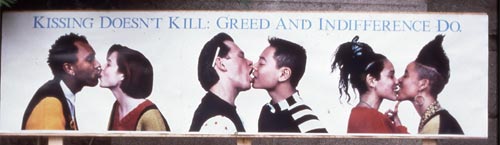
Richard Meyer outlines three strategies used by Gran Fury:
1- mimicing codes of capitalist "pleasure" and visual "seduction" to capture the viewer's attention
2- affirming the power of queer "desire"
3- challenging misinformation about AIDS by rejected wrong stories and accounts, specially about getting AIDS through kissing.
Gran Fury's success lies in the fact that they put their ads/posters in places where one would normally find advertisements and other popular culture media. In a mass culture venue, people are less sceptical of the information, and tend to see them with the same attitude that they would see any other popular culture ad. The viewers also tend to mistake them for mainstream media- adding to the shock value and retention time of the works.
The use of pleasure and desire instead of terror also worked well for Gran Fury. We are a perverse society who takes pleasure in sexual images and voeyurism. Works like Kissing Doesn't Kill allow us to be voeyurs while driving down the street, passing a bus. Gran Fury brings these images to a public that is hungry for them. Gran Fury did not show pathetic victims of AIDS, but individuals like the viewer to evoke anger over misrepresentations.
Gran Fury reached institutional success, though not without challenges. Corporate funders did not like the text under the ad that read "Corporate Greed, Government Inaction, and Public Indifference Make AIDS a Political Crisis". Viewers misunderstood the message of the posters and read them as fighting for the rights of lesbians and gay couple to kiss in public.

SILENCE=DEATH is another work by Gran Fury from 1986. The pink triangle was an ironic appropriation since it was the Nazi symbol for homosexual men in death camps. It questioned Reagan's silence about AIDS. A year later, ACT-UP (AIDS Coalition to Unleash Power) took up action to answer this poster's call. Their civil disobedience and other activist strategies were replete with reproductions of this poster- on buttons, hats, tshirts, anywhere that was visible. Using visuals similar to corporate branding and advertising, ACT-UP make their pink triangle logo a part of the popular culture.
This way, ACT-UP and Gran Fury have borrowed mass media tactics to reach a large audience and get their messages across in the same way ads and everyday popular culture practices do. The only difference is that these collectives shock the viewer into pausing and thinking about the message.
Tactical Media
At the most basic level, tactical media come out of critical cultural practices. It defies authority and bourgeoisie art, as well as other institutional/professional structures. An example of tactical media:
The Critical Art Ensemble (CAE). The CAE has provided us with a concise and complete definition of tactical media:
“Tactical media is situational, ephemeral, and self-terminating. It encourages the use of any media that will engage a particular socio-political context in order to create molecular interventions and semiotic shocks that will contribute to the negation of the rising intensity of authoritarian culture”.
Next 5 Minutes is a group in Amsterdam that utilized the concept of tactical media. They brought together different works that were based on tactical media and fuses art, politics and media. They have information about the festivals on their website.
The Yes Men Institute for Applied Autonomy is another example of a tactical media group. (Note- the website randomly switches from English to French to Spanish- making it very difficult to understand what they do).
One of Canada's most well known media jammers and magazines, Adbusters, is my favorite type of tactical media. The magazine publication is visually interesting and put together with a witty edge that is often lacking in Canadian texts. They take existing media productions and play with the context/content to make a similar ad with a completely inverted meaning. Their collection of "spoof ads" is quite amusing and inspiring for VCC grads who hope to make a differenc in the world like me.
One thing to note about tactical media groups is that they do not wish to bring about radical change or revolutions because they believe that it is not possible to create such massive systemetic movements. Instead, they opt for "molecular" interventions- small movements and interventions similar the ones we did as part of our class. However, after 9/11, the critique on politics and capitalism has gained new life and now asks for revolutionary practices. Tactical media and interventions provide the public with the revolution they need. Gene Ray comments that tactical media are not prepared to fit into this role because of the lack of an overarching strategy or system to resist. It is also important to note that tactical media have now found success in institutions and art worlds even though they were not originally created for such success. As Gene Ray notes,
"Tactical media now finds itself in a world that it did not forsee and that directly undergoes some of its founding assumptions. Mutations of thought, beyond anything so far produced, are needed to adjust theory and practice to the new realities of global anticapitalism and permanent war- and to avoid the neutralizations of official approval".
Another example: the popular iPod posters that had taken over our metropolitan cities were infiltrated and inverted by Forkscrew to make iRaq posters. the iRaq posters followed a similar visual pattern- as you can see in the image. They discussed the death counts, Abu Ghraib and other Iraq war realities that don't always make it into the media.

This is an excellent example of successful visual parodies, detournement, culture jamming, and tactical media.
Activism in India- part 2
Several weeks ago, I had planned on discussing activism in India though the example of Rang de Basanti, a 2006 Bollywood production. However, with a full time job and a full time 4th year course load, I will have to cut my Rang de Basanti analysis short and continue with the weekly lectures/readings.
A few points about Rang de Basanti:
- Riots and protests have been a popular way of reaching a democracy in India. Taking India’s past as an example, specifically the pre-Partition years, we see that civil disobedience movements that Gandhi led, and massive protests in front of Congress were common. Eventually, these tactics helped the public win their way. Rang de Basanti is a good example of that. At Ajay’s death, his loved ones execute a protest in front of the Gateway of India to commemorate Ajay’s unjust death. Later, they ask the masses to protest with them as they inform the public of the hidden corruption in their own government. Power to the People! Indeed.
- Similar to the acts of culture jamming and appropriation in the West, Rang de Basanti shows a group of university students appropriating a popular culture medium- the radio. Through out the film, that radio station plays pop music and celebrity gossip. It forms one of the narratives of the masses who listen to it. At the end, however, the four students lock themselves inside the radio station and send their own messages over the airwaves. They appropriate the medium and use it to deliver a message that opposes the dominant ideologies.
- Activism in the film is shown in an angry tone. Perhaps it is because the students are angry at their friend’s death, or they only became activists through their anger. Whatever the reason, I disagree with it. Like the student projects done in class, it is obvious that activism can serve a social/moral purpose but still be fun. One does not have to be angry or destructive to be an activist. Peaceful activists exist too.
A few points about Rang de Basanti:
- Riots and protests have been a popular way of reaching a democracy in India. Taking India’s past as an example, specifically the pre-Partition years, we see that civil disobedience movements that Gandhi led, and massive protests in front of Congress were common. Eventually, these tactics helped the public win their way. Rang de Basanti is a good example of that. At Ajay’s death, his loved ones execute a protest in front of the Gateway of India to commemorate Ajay’s unjust death. Later, they ask the masses to protest with them as they inform the public of the hidden corruption in their own government. Power to the People! Indeed.
- Similar to the acts of culture jamming and appropriation in the West, Rang de Basanti shows a group of university students appropriating a popular culture medium- the radio. Through out the film, that radio station plays pop music and celebrity gossip. It forms one of the narratives of the masses who listen to it. At the end, however, the four students lock themselves inside the radio station and send their own messages over the airwaves. They appropriate the medium and use it to deliver a message that opposes the dominant ideologies.
- Activism in the film is shown in an angry tone. Perhaps it is because the students are angry at their friend’s death, or they only became activists through their anger. Whatever the reason, I disagree with it. Like the student projects done in class, it is obvious that activism can serve a social/moral purpose but still be fun. One does not have to be angry or destructive to be an activist. Peaceful activists exist too.
Subscribe to:
Posts (Atom)